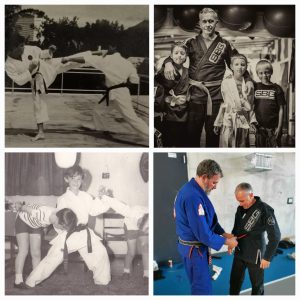
This year (2022) marks fifty years of training. Fifty years of sweating, bleeding and frustration, it is also fifty years of experiencing the joy of progress, insights about myself and learning calmness under pressure. I was exposed to martial arts long before I started training – as a six-year-old I would be watching judo lessons at the Commissioner Street gym and then later would spend most evenings of the week at the Goju-Ryu Fox Street Karate Academy where my mother and her husband worked. A good part of my life has been spent in either a gym or academy – the idea of getting home from work at 5pm is a foreign concept to me.
I can still recall my first karate lesson – it was held a stone’s throw away from the Ellis Park rugby stadium at the Troyeville Portuguese Community Hall sometime in the middle of 1972, I was a bright-eyed nine-year-old who looked forward to the next day’s adventures running through the streets of Hillbrow. The hall where the lessons were conducted was as far as you could possibly get from the allure of a karate dojo; the floor was extra slippery with layers of floor polish and hastily mopped up sticky softdrink from the previous night’s bingo event, we usually had to arrive early to clear the hall of chairs, tables and whatever other flotsam happened to clutter the makeshift dojo. Leading up to my first lesson, my friend and I were pulled away from our usual shenanigans on the Hillbrow streets to make up numbers for a karate class (a cheap rent-a-crowd you could say). The sensei was my mother’s husband, Jose Campos who had received his karate black belt from James Rousseau, one of the doyens of karate in South Africa and his judo black belt from Professor Jack Robinson, a pioneer of judo in South Africa.
My first experience of karate was not the stuff of warriors under the expert tutelage of a grizzled teacher; instead, what we had was five poor souls standing in our own squared-metre location and throwing meaningless punches and blocks in this martial arts Purgatory. Karate then as it is now consisted mainly of attacking the air in front of you, add some oriental kanji, guttural shouts and blend that into a crisp white Shureido gi and pretty soon you’ll be a legend in your own lunchtime. To be honest I was bored most of the time. In fact, so much so, that in one display of sheer boredom and impudent teenage display, I snuck out of a full class to walk across the road and have a beer at the local bar. I returned half an hour later (my ninja skills intact) to witness the same meaningless motions on display in the class.
But I stayed. For twenty-six years … why you may ask? Well, I became fascinated with movement and fighting. So, I drank the karate Kool-Aid and did a deep dive into what was promised. At first it was sport karate and after two years of training, I began to win at sparring events (kumite for the purists), I received my junior karate black belt at 15 years old, and continuing on this trajectory to later win many South African karate titles and gain national Springbok colours. Wanting to better understand what karate was about I began travelling the world from Okinawa and Tokyo, Japan to the USA and Europe in order to get a better grasp and understanding of what Goju-Ryu karate professed itself to be; namely, a power-based system and the Close Quarter style of karate – a supposedly effective self-defence style. In 1990 I moved to Cape Town from Johannesburg, I build up three competitive karate schools and would make a weekly trip to Stellenbosch to train with the country chief instructor, Bakkies Laubscher – he epitomized the occidental wanting to be a Sensei without realising what it actually meant. In one example of leadership incompetence when on the completion of a seminar on nutrition and hydration by a leading sports science lecturer far more qualified than he was; he remarked when the lecturer had left that what we just heard was not true and he and we must continue to not allow water breaks to students. It affirmed what I had always suspected; that karate was more interested in self-flagellation and some kind of false hardship training than in building a competent and efficient student and fighter.
I also studied in what was accessible at that time and learnt Okinawan Kobudo, Tai Chi, Daito-Ryu Aiki-jujutsu, Wing Chun and various other styles of karate, in hindsight I would have gained much more if I had instead enrolled myself in a boxing or wrestling gym (yes this is a regret) I continued training but there was still an internal unease and gaping hole in what I was learning from these arts. So I continued to walk the earth like Caine in Kung-Fu (reference to a popular 70’s TV series for you Millennials and Gen Z) so I took up Kickboxing with a local trainer and found a Xhosa Stick fighter (both these instructors having a proclivity to visiting the local tavern before class making their misdirected blows a health hazard!) Filipino Kali appeared next on my radar and I became an avid practitioner, at the same time I immersed myself in reading all I could find on Bruce Lee’s Jeet Kune Do Concepts (interestingly, SBG became what JKD was trying to be) Around 1995 I bought the complete video series of the “The Dog Brothers Full Contact Stick Fighting” featuring Eric Knaus and it was on this platform that I first saw Brazilian jiu-jitsu, there was a brief demonstration of an arm bar from mount with Carlos Machado. I was immediately intrigued in this mysterious art of the ground. Around this time scratchy videos of the first UFC began to surface in South Africa together with a write up by Tony Blauer on the first UFC in the magazine “Fighting Arts International”. Adding to this dialogue, I befriended Erik Petermann, he of the enquiring mind in all things martial, to this day we can still sit around and chew the fat about fighting arts.
I became fascinated with jiu-jitsu; it was so far removed from what I had learnt in karate – it was like magic and science mixed together. In 1998 the first grappling seminar was conducted in Cape Town by Ludwig Strydom, the seminar essentially was about holding closed guard for as long as possible with some very aggressive hugging! It however did enough to show the gaping hole in my game – that year, I was the South African Goju-Ryu karate champion, a personal fitness trainer and a kickboxer – anyhow, at the seminar I rolled with a student who had about three-months experience in grappling – he smashed me. I remember driving home in a slight state of depression, the following Monday I informed my class of black belts that if I wished to be true to myself and to them, I could no longer teach karate, I became a ronin, a wandering samurai – but still without the effective skill-set.
During my time in the karate world, I met some really good people, namely Sensei Morio Higaonna – a man who personified the word Budo. I learnt about respect and honour which I still hold to this day. I can still recall him talking to me way back in 1986 about ground control positions and effective takedowns. In 1998 he tore up my elbow ligaments from a rear Crucifix position in a demonstration which no one in this country had seen before (and no he didn’t learn that from a kata!), unfortunately, he was tethered to the ideals of karate, I say this with the greatest respect to him but I feel that if he ditched the stultifying dead pattern drills and katas, we would have witnessed a much scarier and efficient version. Mark Brijder was a team mate and rival in the competition world, he achieved senior Springbok colours at the age of 16 (an unheard-of feat then and even now). He was the artist of the set up and with it came a bulldog tenacity in his sparring. In the mid-eighties I started training at a rival karate organisation’s 6am sparring class under Norman Robinson, a very knowledgeable man in judo and the philosophy of fighting. His father was Jack Robinson whose judo classes I watched when I was six years old. His son, Mark Robinson would later fight in the UFC and become an ADCC champion. I was a member of the Defence Force karate team in 1981 and 1982, here I met Mark Liebenberg who also displayed a tough warrior attitude attributable to his Kyokushin karate training. There are many more talented individuals that I met on my travels in Japan, the USA and Europe and always wondered what would have become of them if they freed themselves of the constraints of karate and learnt a more functional art.
Jiu-jitsu in South Africa at the end of the nineties was not as organised as to what we have now, a Rickson Gracie representative came through to Cape Town in 1999 but nothing more happened after that, I started training with Rodney King and his Street Tough organisation in 2000 and in 2001 I met Matt Thornton, who to this day is my jiu-jitsu coach, his ability to make the complicated simple to understand is the reason I and my students have prospered in the jiu-jitsu world.
Martial arts is a difficult beast to master – probably because of this we are drawn to it for its many positive attributes and far-reaching benefits. If doing Tai Chi under a willow tree at dawn, brings you personal fulfilment or winning the kata champion title at the WKF world championships is your life-long dream, I would say that is a beautiful thing. However, do not try to derive self-defence applications from dead-pattern drills – for a) health reasons (you’ll get hurt) and b) your sanity (it doesn’t work) – Georges St-Pierre and Lyoto Machiida did not win UFC titles because of karate – they won it through athleticism and an efficient delivery system of Wrestling, Jiu-jitsu, Boxing and Muay Thai. My experience of the classical or traditional martial arts is that they usually attract personalities more drawn to its historical significance than practicality. Jiu-jitsu, Wrestling, Boxing and Muay Thai have self-correcting mechanisms that allow the student to adjust his form and ability to align with function. It is for this reason that we do not see katas for guard passing, side control, etc.
As I look back at fifty years of training and see the difference between my two black belts; I can truthfully say that the former taught me what doesn’t work in a fight and the later taught me what does work in a fight. I am still fascinated by movement and fighting and training everyday with SBG and jiu-jitsu, I now have an insightful understanding of the dynamics and pathways of this fascinating subject, together with the calmness of mind that we all seek.